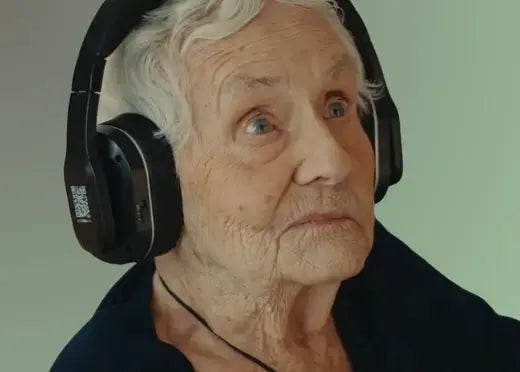

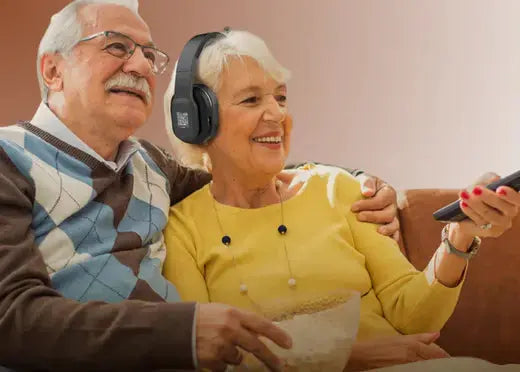
Is the TV volume creeping up every week, causing tension at home? You're not alone. Hearing loss turns a simple evening in front of the screen into a source of frustration — for the person with hearing difficulty and their household alike. Fortunately, TV headphones designed for hearing loss have come a long way. This guide helps you understand the available technologies, key selection criteria, and the most suitable solutions in 2026.
Why a standard TV headset isn't enough for hearing loss
Watching television with hearing loss creates specific challenges. A consumer-grade headset amplifies all sounds equally — dialogue, music, explosions — without distinction. The result: voices remain buried in the mix, and turning the volume up only worsens listening fatigue.
Today's programs use complex audio mixing where dialogue occupies the very frequency range that age-related hearing loss affects first: high frequencies. The person hears the background music, perceives the sound effects, but loses the words.
A TV headset designed for hearing loss addresses these issues:
- Selective dialogue amplification: vocal frequencies are specifically boosted, not the overall sound.
- Independent listening: everyone enjoys the program at their own volume without disturbing others.
- Reduced listening fatigue: calibrated sound requires less concentration effort than simply turning up the volume.
Transmission technologies: Bluetooth, RF, infrared, or bone conduction?
The transmission technology is the first criterion to understand. Each option has its strengths and limitations:
Bluetooth: the most common, but watch for latency
Bluetooth is the most widespread technology. Convenient and compatible with most modern TVs, it does however suffer from a major flaw for TV listening: latency. A 100-200 ms delay between picture and sound makes viewing uncomfortable — lips move before the sound arrives. aptX Low Latency or LE Audio codecs reduce this issue, but not all TVs support them.
Radio frequency (RF): stability first
RF headphones use a transmitter base plugged into the TV. The advantage: a stable connection, 30 to 100 metre range, and no latency issues. This is the preferred technology for specialized TV headphones like the Sennheiser RS or Thomson WHP ranges. The downside: a dedicated transmitter to install, and sometimes less precise sound than Bluetooth.
Bone conduction: the alternative pathway
Bone conduction headphones transmit sound through skull bone vibrations, bypassing the ear canal entirely. A considerable advantage: they work even with earwax buildup or a blocked canal — a common situation among elderly people. Ears remain open, nothing is inserted, and they're compatible with existing hearing aids.
Dual conduction: the best of both worlds
Spokeo's patented dual conduction simultaneously combines air and bone conduction. This dual transmission delivers richer sound perception than either pathway alone — a particularly noticeable advantage for dialogue.
Key criteria for choosing TV headphones for hearing loss
Dialogue clarity
This is criterion number one. A good TV headset for hearing loss doesn't just amplify — it isolates and boosts vocal frequencies (between 500 Hz and 4,000 Hz) so that words stand out clearly from the audio mix. Check that the headset offers a dedicated "dialogue" or "voice" mode.
Long-wear comfort
A film lasts 2 hours; a series marathon can run to 6. The headset's weight, head pressure, and cushion material make all the difference. Over-ear designs (encompassing the ear) are more comfortable than on-ear ones (pressing on it). Bone conduction headphones don't touch the ears at all.
Battery life
For daily TV use, aim for at least 8 to 10 hours of battery life. Some RF headphones offer up to 20 hours. Bone conduction headphones typically provide 5 to 8 hours — enough for an evening, but requiring daily charging.
Ease of use
This criterion is crucial for elderly people or those who struggle with conventional hearing aids. Ideally: switch on, place on head, listen. No menu, no Bluetooth pairing each time, no batteries to change.
TV compatibility
Check your TV's audio outputs before buying: 3.5 mm jack, optical (Toslink), RCA, HDMI ARC? RF headphones typically come with a multi-connector base. For Bluetooth, your TV needs to be compatible — otherwise, a Bluetooth adapter (€10-30) solves the problem.
Spokeo in TV mode: a different approach to television listening
Winner of the Grand Prix at the Concours Lépine International 2025
Spokeo isn't a traditional TV headset. It's a versatile listening assistant that works for direct conversation as well as Bluetooth TV mode. Its patented dual conduction technology (air + bone) delivers sound clarity that conventional headphones cannot match — especially for people with blocked ear canals.
What sets Spokeo apart for TV listening
Why Spokeo goes beyond a simple TV headset
Most TV headphones do one thing: transmit television sound to your ears. Spokeo does both: in Bluetooth mode, it connects to your TV for personalised listening. In Smart Mic mode, the speaker wears the clip-on microphone and their voice is delivered directly to the headset — perfect for conversations, medical consultations, or family visits.
This versatility makes it a smarter investment than a dedicated TV headset: instead of buying one device for TV and another for conversations, Spokeo covers both in a single kit.
Spokeo in TV mode is particularly suited if:
- You can no longer tolerate in-ear tips or your hearing aids are uncomfortable during TV viewing
- You also need help with conversations, not just television
- Your loved one in a care home can no longer manage a hearing aid but wants to follow their programs
- You want a no-prescription, ready-to-use solution with no audiologist appointment
- TV volume has become a source of conflict in your household
→ Discover the Spokeo kit: myspokeo.com
TV headphone comparison for hearing loss
| Criterion | Dedicated RF TV headset | Standard Bluetooth headset | Spokeo (dual conduction) |
|---|---|---|---|
| Average price | €80 – 200 | €30 – 300 | €598 incl. tax |
| Usage | TV only | Music / calls / TV | TV + direct conversations |
| Bone conduction | No | No (except specific models) | Yes (patented dual conduction) |
| Works with earwax | No | No | Yes |
| Conversation microphone | No | No | Yes (directional Smart Mic) |
| Latency | Near zero | Variable (50-200 ms) | Depends on TV Bluetooth |
| Prescription required | No | No | No |
Tip: if your needs are strictly limited to TV listening and your hearing is mildly affected, a dedicated RF headset at €100-150 may suffice. However, if you need help with both TV and conversations — or if your ear canal is frequently blocked — Spokeo offers a more complete solution. An overview of hearing aid alternatives can also help you decide.
How to connect TV headphones for hearing loss to your television
Setup depends on the headphone type and your television:
If your TV has built-in Bluetooth
This is the simplest scenario. Enable Bluetooth in your TV settings (usually under "Sound" or "Accessibility"), put the headset in pairing mode, and select it from the list. For Spokeo: hold the headset power button for 3 seconds to enter Bluetooth pairing mode.
If your TV doesn't have Bluetooth
No problem. A Bluetooth adapter (transmitter) plugs into your TV's audio output (3.5 mm jack, optical, or RCA) and creates the Bluetooth signal. Expect to spend €15 to 30 for a quality adapter. Models with aptX Low Latency offer the best audio-visual synchronisation.
For RF headphones with a transmitter base
Plug the transmitter base into the TV's audio output, place the headset on the base to charge and pair, and you're ready. Most bases include the necessary cables (jack, RCA, optical).
Frequently asked questions about TV headphones for hearing loss
What is the best wireless TV headset for hearing loss?
The best headset depends on your needs. For TV-only use, RF headphones (Sennheiser RS, Thomson WHP) offer stability and good battery life at €80 to 200. If you also need help with conversations and your ear canal is sometimes blocked, Spokeo (€598 incl. tax) combines patented dual conduction and a directional Smart Mic to cover both uses.
How can someone with hearing loss watch TV without disturbing others?
The most effective solution is a dedicated wireless headset. It receives sound directly from the TV, allowing you to set your own volume without affecting the television speakers. Bluetooth or RF headphones provide this independence. Some Smart TVs also allow simultaneous output to both speakers and headphones.
Can bone conduction headphones be used to watch television?
Yes. Bluetooth bone conduction headphones connect to a TV like any wireless headset. Their advantage: they work even when the ear canal is blocked (common earwax buildup in seniors) and leave the ears open. Spokeo uses patented dual conduction (bone + air) which delivers superior sound quality to bone conduction alone.
Does Spokeo work with television?
Yes. In Bluetooth mode, Spokeo connects wirelessly to any Bluetooth-compatible television. If your TV doesn't have Bluetooth, a Bluetooth adapter (€15-30) is all you need. Spokeo also offers a Smart Mic mode for direct conversations, making it a versatile listening assistant — not just a TV headset.
Which TV headset should I choose for an elderly person in a care home?
In care homes, ease of use is the top priority. Headsets with charging docks and automatic pairing are ideal. Spokeo is particularly suited as it requires no complex settings (2 pre-set volume levels), works even with earwax buildup, and can also be used for conversations with nursing staff or family during visits.
Can a TV headset for hearing loss replace a hearing aid?
No, a TV headset does not replace a hearing aid for daily life. It is designed for media listening (TV, music, podcasts). However, some devices like Spokeo combine TV listening and conversation assistance, making them a useful complement — or even an alternative for people who cannot or no longer wish to wear traditional hearing aids.
Conclusion
TV headphones for hearing loss are no longer a gadget — they're a tool that restores the pleasure of television and peace within the household. Whether you choose an affordable RF headset or a versatile solution like Spokeo, the key is not to let hearing loss isolate you from your programs and your loved ones.
With its patented dual conduction and directional Smart Mic — winner of the Concours Lépine 2025 —, Spokeo goes beyond a simple TV headset by also providing conversation assistance. For people who can no longer or no longer wish to wear traditional hearing aids, it's a solution worth considering.