

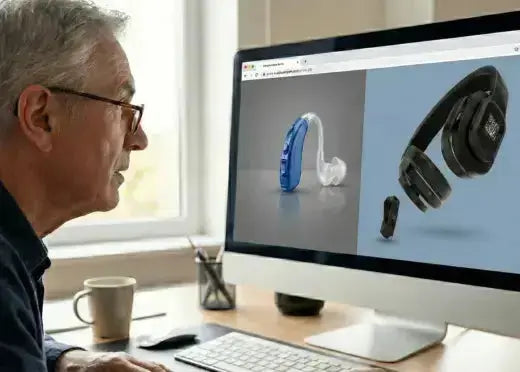
Faced with hearing loss, many seniors believe that hearing aids are the only solution. However, alternatives exist: CROS systems, cochlear implants, or innovative listening devices like Spokeo (winner of the 2025 Lépine Competition). Discover the options tailored to your situation to improve your quality of life without compromise.
The limitations of traditional hearing aids
Traditional hearing aids remain an effective solution for many people, but they are not suitable for everyone. Some seniors find them too complicated to use, while others find them uncomfortable or inconspicuous. Cost can also be a significant deterrent: between €1,500 and €3,000 per ear , even with available reimbursements.
In addition, some situations require different approaches: conductive hearing loss, obstructed auditory canal, or cognitive disorders making daily handling difficult (approximately 30% of elderly people with hearing loss according to the Lisan 2022 study).
If your hearing loss is age-related, our comprehensive guide on presbycusis: how to hear better as you age covers all your options.Overview of alternatives to traditional prostheses
Several solutions have been developed to meet the diverse needs of people with hearing impairments:
- CROS/BI-CROS systems for unilateral hearing loss
- Bone-anchored implants to bypass ear canal problems
- Cochlear implants for profound deafness
- Listening assistants like Spokeo for occasional use without a prescription
- Assistance systems for specific situations (TV, telephone, public places)
CROS and BI-CROS systems for unilateral hearing loss
For people with unilateral deafness (hearing loss in one ear), CROS (Contralateral Routing of Signal) systems offer an ingenious solution. A microphone placed on the side of the hearing-impaired ear picks up sounds and transmits them wirelessly to a device worn on the hearing ear.
The BI-CROS system works on the same principle, but is suitable for people with hearing loss in both ears, with one ear completely deaf and the other retaining partial hearing. Average price: €2,000 to €3,500, with a doctor's prescription.
Bone-anchored implants: a surgical solution
For certain types of conductive or mixed hearing loss, bone-anchored implants offer an effective alternative. This medical solution requires minor surgery to fix an implant in the mastoid bone, behind the ear. An external audio processor then transmits sound vibrations directly to the inner ear via bone conduction.
This technology bypasses problems of the external auditory canal and middle ear, making it particularly suitable for patients suffering from chronic otitis, congenital malformations, or severe otosclerosis.
Cochlear implants for profound deafness
When hearing loss is so severe that traditional hearing aids no longer provide any benefit, a cochlear implant may be a last resort. This sophisticated medical device is surgically implanted in the inner ear and directly stimulates the auditory nerve.
Unlike hearing aids that amplify sounds, a cochlear implant converts them into electrical signals. Cost: over €15,000, generally covered by health insurance for eligible cases.
Sound amplifiers and listening assistants: the no-prescription alternative
If your hearing loss is mild to moderate and you are looking for an immediate solution, with no prescription or medical pathway, sound amplifiers and listening assistants are the most accessible alternative. Sold without a prescription, in pharmacies and online, they amplify everyday sounds without the personalised settings of a hearing aid.
Two very different families should be distinguished:
- Basic sound amplifiers (€50 to €200): they amplify every sound indiscriminately, background noise included. Handy as a stopgap, but tiring as soon as several people are around.
- Smart listening assistants such as Spokeo: they filter ambient noise and focus on the speaker's voice, for clear understanding even in a group. This is the most advanced category, the closest to a true hearing aid.
Where can you get a listening assistant?
These devices can be bought freely: in pharmacies, in specialised stores or directly online. Buying online often includes a trial period and phone support, valuable for a first device.
What about smartphone amplification apps?
Some apps turn a smartphone into a backup amplifier, using its microphone and earphones. Convenient for an impromptu conversation, they remain limited: variable quality, battery dependence and insufficient comfort for regular use. They help out, but do not replace a dedicated device.
What families say: "My mother, 87, lives in a care home. The day she could no longer wear her hearing aids, she found herself isolated, cut off from communication. With Spokeo, she reconnected." (Claudine B., daughter of a user)
Spokeo: the next-generation listening assistant
An immediate alternative without a medical procedure
Unlike hearing aids which require prescription, adjustments by hearing aid specialists and regular follow-up, Spokeo (winner of the 2025 Lépine International Competition ) offers a radically different approach for people with mild to moderate hearing loss .
Patented bi-conduction technology
Spokeo uses a patented technology combining air conduction and bone conduction . This dual transmission guarantees optimal sound quality even in cases of earwax buildup or partial obstruction of the ear canal. The system includes:
- Smart Mic directional HD : lavalier microphone that captures the speaker's voice while filtering out ambient noise (Bluetooth range: 10 meters)
- Ergonomic Sound Boost headphones : deliver sound via dual conduction with noise isolation
- 2 pre-recorded volume levels : cover 95% of mild to moderate hearing loss
- 5 hours of continuous use, full recharge in 2 hours
Distinctive features
Ideal use cases for Spokeo
Spokeo excels in one-off communication situations where understanding is crucial:
believe that Spokeo improves the quality of exchanges and facilitates obtaining informed consent.
result in time savings and a reduction in repetitions (savings: €25,000/year/establishment)
notice a decrease in frustration during interactions with their hearing-impaired loved one
- Medical consultations : important dialogues requiring clear understanding
- Care in nursing homes : medication administration, daily care, interviews
- Family visits : moments of sharing in sometimes noisy environments
- Conversations at home : with caregivers, during meals, in front of the television (Bluetooth mode)
Spokeo is particularly suitable if:
- You find hearing aids too complex to handle and/or maintain
- You suffer from cognitive impairments that make adjustments and acceptance difficult
- Are you looking for a complementary solution to your current devices?
- You need occasional hearing assistance (for consultations, visits)
- Your budget does not allow for the purchase of a medical prosthesis.
- You are a healthcare professional looking to improve communication with your patients
→ Learn more about Spokeo: www.myspokeo.com
Support systems for specific situations
Beyond the devices worn continuously, there are targeted assistance systems for specific situations:
- Magnetic loops : installed in many public places (theatres, ticket offices, churches) and transmit sound directly to compatible hearing aids.
- Wireless TV headphones with amplification : allow you to listen at a comfortable volume without disturbing those around you.
- Amplified telephones : with enhanced volume and hearing aid compatibility
- Light-up doorbells and vibrating alarm clocks : for everyday independence
Comparative table of alternative solutions
| Solution | Average price | Prescription | Facility | Use | Ideal for |
|---|---|---|---|---|---|
| Hearing aid | €1,500-€3,000 | Yes | Hearing aid specialist + adjustments | Permanent | Moderate to severe permanent loss |
| Cochlear implant | >€15,000 | Yes | Surgery + rehabilitation | Permanent | Profound bilateral deafness |
| Spokeo | €598 | No | Plug & play | Punctual | Refusal/unsuitability for conventional hearing aids |
| CROS/BI-CROS | €2,000-€3,500 | Yes | Hearing aid specialist | Permanent | Unilateral deafness |
| Bone anchoring implant | €5,000-€8,000 | Yes | Minor surgery | Permanent | Conductive hearing loss, malformations |
| Basic amplifiers | €50-200 | No | None | Punctual | Simple amplification without filtering |
Frequently asked questions about alternatives to hearing aids
Does Spokeo require a medical prescription?
No, unlike medical hearing aids, Spokeo is available without a prescription . It's a personal sound amplification product (PSAP), not a medical device. You can buy it directly from myspokeo.com and use it immediately.
What is the price of Spokeo and is it refundable?
Spokeo costs €598 including VAT , which is 4 to 10 times less expensive than a traditional hearing aid. It is not covered by French national health insurance (Sécurité sociale) because it is not a medical device, but its affordable price makes it accessible without prohibitive out-of-pocket expenses. For institutions (nursing homes, hospitals), funding through the healthcare budget or Non-Renewable Credits (CNR) is possible.
Is Spokeo suitable for people with cognitive impairments?
Yes, that's precisely one of Spokeo's major advantages. Many elderly people with hearing loss and cognitive impairments cannot effectively use traditional hearing aids due to their complexity. Spokeo offers two simple preset settings (volume 1 or 2), a familiar headphone design, and a magnetic microphone (no complicated connections). It can be used by caregivers without any specific training.
What is the difference between Spokeo and a conventional hearing aid?
The main differences are:
Hearing aid: personalized medical device, worn continuously, adjusted by a hearing aid specialist, price €1,500-€3,000, prescription required
Spokeo: listening assistant, for occasional use (consultations, meals, visits), 2 standardized settings, price €598, no prescription required, ready to use
Spokeo does not replace a prosthesis for permanent use, but excels in targeted communication situations where simple and effective amplification is sufficient.
Can Spokeo be used in conjunction with hearing aids?
Absolutely. Many hearing aid users use Spokeo as a supplement in challenging situations : important medical appointments, noisy family meals, or when they want to give their ears a break from wearing in-ear headphones all the time. Spokeo's Bluetooth mode also allows you to use it to watch television without disturbing others.
What is Spokeo's battery life?
Spokeo offers up to 5 hours of battery life with continuous use. A full charge (headset + microphone) takes approximately 2 hours via USB-C. The Smart Mic magnetically attaches to the headset for automatic charging, without any complicated steps.
Where can you buy a listening assistant? Is it available in pharmacies?
Yes. As it is sold without a prescription, you can find it in pharmacies, in specialised stores and online. Spokeo is available directly on myspokeo.com, with home delivery and phone support.
What can you do when hearing aids are no longer enough or are refused?
When a hearing aid becomes too complex to handle, poorly tolerated or refused, the goal is no longer to fit one at all costs, but to restore communication. An occasional listening assistant like Spokeo makes it possible to reconnect at key moments (meals, appointments, visits), with no medical commitment. For relatives facing a refusal, our guide My loved one refuses their hearing aids sets out the possible approaches.
Are there financial aids for these alternatives?
Listening assistants are not covered by France's "100% Santé" scheme, which is reserved for class I medical hearing aids. For individuals, however, some complementary health insurers or pension funds offer occasional support to help maintain independence. For care facilities (nursing homes, hospitals), funding goes through the care budget or Non-Renewable Credits (CNR).
How to choose the most suitable solution?
The choice of solution depends on several factors that must be carefully evaluated:
- Type and degree of hearing loss : mild, moderate, severe, or profound
- Frequency of use : ongoing need or occasional situations
- Manipulation skills : fine dexterity, possible cognitive impairments
- Lifestyle : active, sedentary, frequent exposure to noisy environments
- Available budget : with or without the possibility of reimbursement
- Personal preferences : discretion, comfort, technology
Tip: It is essential to consult a hearing healthcare professional (ENT specialist or hearing aid specialist) for a complete hearing assessment. Some situations may benefit from a combination of solutions : for example, hearing aids for everyday use + Spokeo for medical appointments or family visits in noisy environments.
When refusal to wear hearing aids blocks all care options, other approaches are possible. Read our caregiver guide: My loved one refuses hearing aids: what to do as a caregiver.
The importance of not letting hearing loss become established
Whatever solution you choose, the key is to act quickly at the first signs of hearing loss. Early intervention preserves the brain's ability to process sounds and facilitates adaptation to any type of hearing aid.
The link between untreated hearing loss and cognitive decline is now scientifically established. A study published in The Lancet (2020) shows that 9% of dementia cases could be prevented by better hearing care, compared to smoking (5%), physical inactivity (3%), and obesity (1%).
Furthermore, regaining good hearing helps maintain social connections, prevents isolation, and significantly improves the quality of life for seniors and their caregivers.
Conclusion
Alternatives to traditional hearing aids are numerous and constantly evolving technologically. From sophisticated implants to innovative listening assistants like Spokeo , everyone can now find a solution tailored to their individual situation.
The important thing is to be informed, to consult qualified professionals, and never to consider hearing loss as an inevitable fate. Communication remains central to human relationships, and preserving this ability represents a valuable investment in the well-being and independence of seniors.