

Hearing loss and Alzheimer's disease affect millions of older adults. Long considered two separate conditions, they are in fact closely connected. Even more concerning: they feed into each other in a vicious cycle that's difficult to break. Understanding this connection is essential for caregivers, healthcare professionals, and seniors themselves.
A Scientifically Proven Link
Recent studies leave no room for doubt: untreated hearing loss is the number one modifiable risk factor for dementia. According to a meta-analysis published in The Lancet in 2020, hearing impairment accounts for approximately 8 to 9% of preventable dementia cases worldwide—more than smoking (5%), physical inactivity (3%), or social isolation.
A study published in 2025 in JAMA Open Network reveals even more striking data:
- 80% of people with Alzheimer's also suffer from hearing loss
- This figure reaches 94% after age 85
- Mild hearing loss doubles the risk of dementia
- Moderate hearing loss triples it
- Severe hearing loss multiplies it by five
These numbers confirm that the link between hearing and cognitive health is much stronger than previously thought.
Three Mechanisms That Explain This Link
1. Cognitive Overload
When a hearing-impaired person tries to follow a conversation, their brain works overtime to decode sounds. This constant cognitive overload drains resources that would normally be dedicated to memory, reasoning, and attention. Over time, this excessive strain exhausts cognitive capacity and accelerates mental decline.
2. Social Isolation
Hearing loss complicates social interactions. People with hearing impairment gradually avoid conversations—especially in noisy environments—leading to isolation. Yet lack of social stimulation is itself a recognized risk factor for dementia. Studies show that the combination of hearing loss and social isolation increases dementia risk by 70%.
3. Brain Atrophy
Medical imaging reveals that hearing loss is associated with accelerated atrophy of brain areas responsible for sound processing and memory. The lack of auditory stimulation leads to degeneration of brain structures, contributing to cognitive decline.
The Vicious Cycle: When Alzheimer's Makes Hearing Aids Impossible
Here's the cruel paradox: the people who most need to hear well to maintain their cognitive abilities are precisely those who can no longer manage a traditional hearing aid.
Hearing loss → Isolation + cognitive overload → Cognitive decline
↑ ↓
Hearing worsens ← Unable to manage hearing aid ← Alzheimer's
It's a snake eating its own tail: hearing loss promotes cognitive decline, and cognitive decline prevents correcting hearing loss.
Why Traditional Hearing Aids Often Fail with Alzheimer's
Traditional hearing aids are designed for autonomous individuals who can manage a device daily. But cognitive impairment changes the equation:
- Forgetting to put them on each morning
- Frequent loss: thrown away with tissues, dropped, lost in bedsheets
- Unable to change batteries or recharge the device
- Refusing to wear them: the person no longer understands their purpose
- Impossible maintenance: cleaning, adjustments, audiologist appointments
- Too complex to handle: tiny buttons, fine motor skills required
According to a study by Lisan published in 2022, up to 30% of hearing-impaired elderly with significant cognitive impairment cannot fully benefit from traditional hearing aids.
The result: these individuals end up without a hearing solution, their communication deteriorates, their isolation deepens, and their cognitive decline accelerates. The vicious cycle closes.
Faced with this situation, family caregivers play a central role. When traditional hearing aids are no longer an option, alternatives exist: My loved one refuses hearing aids: what to do as a caregiver.
How to Break This Vicious Cycle
Act Early: Hearing Aids Before Cognitive Decline
The best strategy remains prevention. According to a study by the Hearing Foundation (2023), wearing hearing aids cuts cognitive decline in half for at-risk individuals. Nearly 30% of dementia risk linked to hearing loss could be prevented through early treatment.
That's why regular hearing screening after age 60 is recommended: identifying and treating hearing loss before cognitive issues appear dramatically changes the prognosis.
To learn more about presbycusis and how to hear better as you age, read our dedicated guide.When Hearing Aids Are No Longer Enough: Hearing Assistants
For people already affected by cognitive impairment, or for whom traditional hearing aids don't work, alternatives exist. Hearing assistants offer a different approach, adapted to real-world challenges.
Spokeo: The Solution When Hearing Aids Are No Longer Manageable
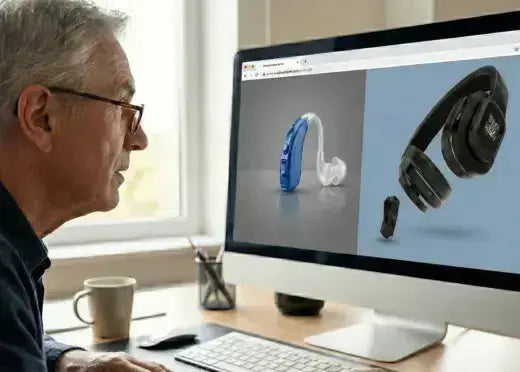
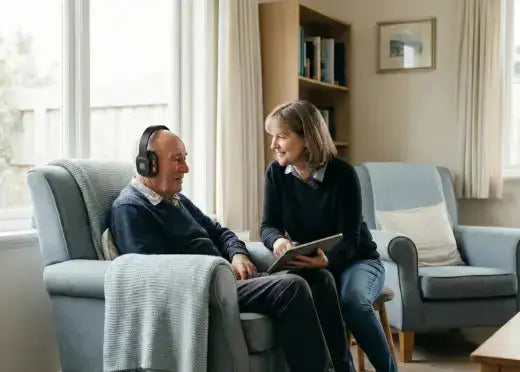
The Spokeo hearing assistant was designed specifically for this problem. Its key feature: the caregiver wears the microphone, not the patient.
This reversal changes everything for people with cognitive impairment:
- No handling required by the Alzheimer's patient
- No adjustments to make, no batteries to change
- Occasional use: put it on to communicate, put it away afterward—less risk of loss
- The caregiver stays in control of the device
- Dual conduction technology: sound gets through even with earwax blockage
Spokeo allows you to maintain communication with a loved one affected by Alzheimer's, even when traditional hearing aids are no longer an option. It's a concrete way to break the vicious cycle.
Recognizing the Signs of Hearing Loss
Early detection is crucial. Here are the signs to watch for in a loved one:
- Frequently asking others to repeat themselves
- Gradually increasing the TV volume
- Difficulty following conversations in noisy environments
- Avoiding social situations or family gatherings
- Feeling exhausted after verbal exchanges
- Appearing absent or distant when spoken to
- Progressively withdrawing (fewer outings, fewer interactions)
If you notice several of these symptoms, consult an ENT specialist or audiologist for a complete evaluation. And if the person already shows cognitive impairment, consider adapted solutions like hearing assistants for caregivers.
Key Takeaways
The link between hearing loss and Alzheimer's is no longer a hypothesis: it's scientific fact. Hearing impairment is the number one modifiable risk factor for dementia.
But this link works both ways: Alzheimer's often makes traditional hearing aids impossible to manage, which worsens hearing loss and accelerates decline. It's a vicious cycle that must be broken.
The solution involves early screening, appropriate hearing devices, and—when traditional aids no longer work—alternatives like Spokeo, which help maintain communication and social connection, the true defenses against isolation and cognitive decline.
FAQ: Hearing Loss and Alzheimer's
Can hearing loss cause Alzheimer's?
Hearing loss doesn't directly cause Alzheimer's, but it is the number one modifiable risk factor for dementia. It increases risk through three mechanisms: cognitive overload, social isolation, and brain atrophy. Mild hearing loss doubles dementia risk, moderate loss triples it, and severe loss multiplies it by five.
Can hearing aids prevent Alzheimer's?
Yes, wearing hearing aids significantly reduces risk. According to the Hearing Foundation (2023), hearing aids cut cognitive decline in half for at-risk individuals. Nearly 30% of dementia risk linked to hearing loss could be prevented through early treatment.
Why don't Alzheimer's patients wear their hearing aids?
Cognitive impairment makes managing traditional hearing aids difficult: forgetting to wear them, frequent loss, inability to change batteries, refusing to wear them due to not understanding their purpose. According to the Lisan study (2022), up to 30% of hearing-impaired individuals with cognitive impairment cannot benefit from traditional hearing aids.
How do you communicate with someone who has both Alzheimer's and hearing loss?
Choose a quiet environment, speak slowly and clearly, position yourself face-to-face to allow lip reading. Hearing assistants like Spokeo make communication easier: the microphone worn by the caregiver transmits voice directly to the patient's headset, requiring no handling on their part.
What's the difference between Spokeo and a hearing aid?
A hearing aid is a medical device worn permanently, customized by an audiologist. Spokeo is an occasional hearing assistant, available without prescription, where the caregiver wears the microphone. This difference makes it suitable for people with cognitive impairment who can no longer manage traditional hearing aids.
At what age should you get your hearing tested?
Hearing screening is recommended starting at age 60, then annually. Identifying and treating hearing loss before cognitive issues appear dramatically changes the prognosis. Don't wait for the first signs of decline to see an ENT specialist or audiologist.