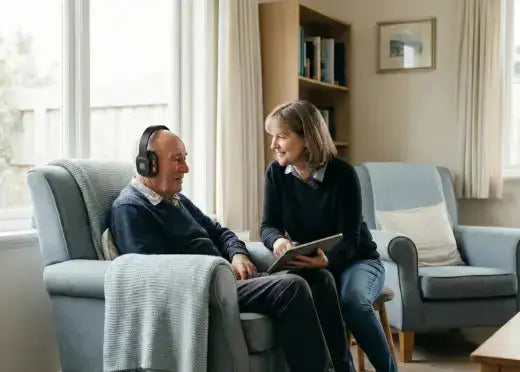

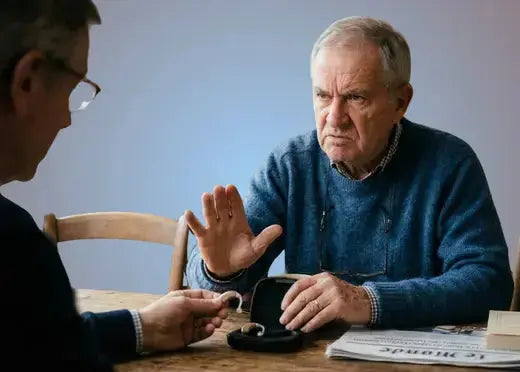
You repeat every sentence twice. You raise your voice without realizing it. The TV is so loud the neighbors can hear it. And when you suggest a hearing aid, the answer is always the same: "I don't need one." If this sounds familiar, you're not alone. This guide is for you, the son, the daughter, the spouse, the caregiver, anyone looking for solutions when a loved one refuses or cannot wear hearing aids.
The essentials
What can you do if a loved one refuses hearing aids?
Worldwide, over 80 % of people with hearing loss do not use hearing aids, so refusal is the norm, not the exception. The good news: a caregiver has several levers without forcing the issue. First, adjust how you communicate: speak face to face, articulate without shouting, cut background noise before starting a conversation. Second, tackle situations one at a time rather than "the hearing problem": amplified TV headphones settle the volume conflict, a personal amplifier helps occasionally. Third, the options that ask almost nothing of the person: with a listening assistant that uses a remote microphone, the speaker wears the mic and the voice arrives clearly in a headset that is simple to put on, with no setup or prescription. Each option has its uses; the table below compares them. The key point stays the same: find a device the person will actually accept, for a specific situation.
The solutions at a glance
There is no single right answer: the best solution is the one your loved one will accept, for a given use. Here are the main families of solutions, compared.
| Solution | What it asks of the person | Best for | Typical price |
|---|---|---|---|
| Adjusting how you communicate | Nothing | An everyday complement | Free |
| Amplified or wireless TV headphones | Wearing a headset for TV | The TV volume conflict | €30 to €250 |
| Personal sound amplifier (PSAP) | Wearing a small in-ear device | Occasional help, low budget | €20 to €300 |
| Listening assistant with a remote mic (e.g. Spokeo) | Putting on a headset; the speaker wears the mic | Conversations, meals, visits, cognitive impairment | ~€600 |
| Traditional hearing aids | Daily wear, adjustments, ENT pathway | Established loss, permanent wear accepted | €0 (with full coverage) to €3,000/ear |
Why refusing hearing aids is so common among seniors
According to the World Health Organization, over 80% of people with hearing loss worldwide do not use hearing aids. This means that the vast majority of hearing-impaired seniors live without any auditory assistance, and their families live with the daily consequences of that choice.
This refusal isn't denial. It has real, concrete causes that are important to understand before looking for solutions.
A hearing loss that creeps in unnoticed
Age-related hearing loss (presbycusis) develops gradually. The person adapts without realizing it: they lip-read, ask people to repeat themselves, turn up the volume. When family members suggest hearing aids, the senior doesn't feel the urgency because, from their perspective, they're "managing fine."
This gap in perception between the person with hearing loss and their family is one of the most common sources of tension in households dealing with hearing impairment.
The very real discomfort of hearing aids
The refusal isn't always irrational. Many people who have tried hearing aids report genuine discomfort:
- Physical pain: poorly fitted ear molds, ear canal irritation, pressure sensation.
- Disappointing sound quality: amplification of all sounds (cutlery, background conversations, ambient noise), echo of one's own voice (occlusion effect), whistling (feedback).
- Complex handling: changing batteries, daily cleaning, fine-tuning settings, tasks that become especially difficult with arthritis, tremors, or cognitive impairment.
Studies show that approximately 30% of elderly people with hearing loss and cognitive disorders simply cannot use traditional hearing aids effectively (Lisan study, 2022). It's not that they won't: it's that they can't.
For more on this topic, read our detailed article: Uncomfortable hearing aids: what are the solutions?
Cost and the medical pathway as barriers
Even in countries with hearing aid subsidies, the fitting process remains demanding: ENT consultation, audiogram, trial of multiple models, adjustment appointments over several weeks. For a very elderly, fatigable person, or someone living in a care facility, each step can become an obstacle.
And if the device is lost or broken (common in residential care), replacement costs can range from €1,500 to €3,000 per ear, often entirely out of pocket.
The psychological dimension: stigma and loss of control
Wearing a hearing aid means admitting you're aging. For some seniors, accepting a hearing device feels like accepting dependency. This refusal is sometimes an act of resistance, the last area where they feel they still have a choice.
As a caregiver, pushing too hard can deepen the resistance. Understanding this psychological dimension is essential before suggesting alternatives.
What you can do as a caregiver
Adjust your communication habits
Before talking about technology, a few simple adjustments can significantly improve everyday conversations:
- Speak face to face, making sure your face is well-lit. Lip reading naturally compensates for part of the hearing loss.
- Speak clearly without shouting: shouting distorts sounds and makes lip reading harder.
- Reduce background noise before starting a conversation: turn off the TV, close the window.
- Rephrase instead of simply repeating the same sentence louder.
These communication tips are covered in depth in our guide: How to communicate effectively with a hearing-impaired person
The television problem
"My mom has the TV so loud it shakes the walls." This is probably the most common complaint from caregivers. Television is often the elderly person's last connection to the outside world: news, shows, entertainment. When they can't hear, they turn up the volume, creating an ongoing conflict with everyone around them.
Specific solutions exist for this: amplified TV headphones, wireless bone conduction headsets, or hearing assistance devices with Bluetooth TV connectivity. The key is finding a device the person will actually agree to wear, and that's often easier than a traditional hearing aid, because a TV headset is associated with pleasure (watching TV), not with a disability.
To compare the available options: TV headphones for hearing loss: which type to choose based on your needs
What if the change came from the speaker instead?
A radically different approach
In the traditional model, everything falls on the person with hearing loss: they must wear the device, visit the audiologist, tolerate the discomfort. The family waits for the problem to be "fixed" on the hearing-impaired person's end. But there's a different approach: instead of forcing a device into your loved one's ear, you, the speaker, wear a microphone.
How it works
You speak normally, and your voice is transmitted directly to a headset worn by the hearing-impaired person, clearly, without background noise, without having to shout. This is exactly how the Spokeo listening assistant works: see how it helps you communicate with a loved one with hearing loss.
The microphone (Smart Mic) clips onto the speaker's collar and transmits their voice in high definition to the headset worn by the listener. The headset uses patented dual-conduction technology (air + bone conduction), which means it works even when earwax is blocking the ear canal, a very common issue among elderly people.
What makes this approach different
report less frustration during conversations with their hearing-impaired loved one
4 to 10 times less expensive than traditional hearing aids, with a 30-day satisfaction guarantee
of continuous use, full recharge in 2 hours via USB-C
Source for the 65% figure: internal Spokeo survey conducted in 25 care facilities, from late 2024 to mid-2025 (questionnaires to families).
Spokeo won the Grand Prix at the Lépine International Innovation Competition 2025 and is now deployed in numerous care facilities across France to improve communication between staff and residents.
For a comprehensive look at hearing aid alternatives: What are the alternatives to hearing aids in 2026?
→ Discover Spokeo: Order the Spokeo set
A caregiver's experience
"My mother, 87, is in a care home. She's full of life and took part in all the activities and the karaoke. Until the day she could no longer wear her hearing aids. It was terrible for her, she found herself with no communication and isolated. With Spokeo, she got back in touch."
Claudine B., verified review. Average rating 4.3/5 across more than 100 reviews. Read customer reviews
How to bring up the subject with your loved one
In practice, four steps help an older person accept a solution:
- Start from a factual, caring observation, not a diagnosis.
- Propose a solution for a specific situation (the television, a family meal), rather than "the hearing problem".
- Present it as a gain in independence, never as dependency.
- Leave the choice and the time: it's the person's buy-in that makes the solution last.
Avoid direct confrontation
Saying "You need a hearing aid" is the surest way to trigger a refusal. Try factual, caring observations instead: "I've noticed you have trouble following the conversation when we're at the table together, it worries me a little."
Start with a specific situation, not the big picture
Instead of trying to "fix the hearing problem," propose a solution for one concrete situation: "How about we try a headset so you can enjoy TV more comfortably?" Accepting a tool for a specific use is much easier than accepting a permanent device.
Frame it as independence, not dependency
Present the solution as something that strengthens autonomy ("You'll be able to follow the conversation at the restaurant without asking me to repeat") rather than as a crutch ("You need help hearing"). The person's buy-in is essential for any solution to work long-term.
When to consult a hearing professional
A stake that goes beyond hearing. According to the Lancet Commission on dementia prevention (2020, updated in 2024), untreated hearing loss is the leading modifiable risk factor for dementia in midlife, linked to about 8% of cases. Maintaining communication therefore matters well beyond comfort. No hearing solution, Spokeo included, "prevents" dementia: the goal is to keep the person from cutting themselves off from conversations. That is also why, faced with a refusal, a simple solution that preserves the connection is better than isolation in the meantime. More on the link between hearing and cognition.
Refusing hearing aids doesn't mean giving up on medical care entirely. An ENT consultation can identify the type and degree of hearing loss, rule out treatable causes (earwax buildup, ear infection), and point toward the most suitable solution.
Tip: If the person categorically refuses a medical consultation, starting with a simple, non-medical solution, like a listening assistant, can help restore everyday communication and sometimes gradually open the door to more comprehensive care.
To understand the challenges of hearing loss in dependent elderly people: Hearing aids and dependency: why it doesn't work
Frequently asked questions
My parent refuses to wear anything on their ears. Are there solutions that don't require anything from them?
Yes, in part. No solution asks literally zero effort, but some ask very little of the person. The key is to shift the effort to the speaker. With a listening assistant that uses a remote microphone, you (the caregiver, the care worker) wear the mic; your loved one only has to put a headset over their ears, with no in-ear mold, no setup and no prescription. They can take it off whenever they want. This is what sets the approach apart from a traditional hearing aid, which relies entirely on the person with hearing loss (permanent wear, handling, ENT pathway). For someone who is reluctant or has cognitive impairment, that simplicity often makes the difference between refusal and acceptance. Spokeo works this way, but the reasoning holds for the whole category.
My parent has the TV volume way too loud. What's the simplest solution?
A TV headset connected via Bluetooth or radio frequency lets the person hear at a comfortable volume without disturbing others. Spokeo offers a TV mode (Bluetooth connection) in addition to its conversation mode, so you don't need two separate devices.
Can a listening assistant replace hearing aids?
No. A listening assistant like Spokeo is not a medical device and doesn't correct hearing loss frequency by frequency. It's designed to improve speech comprehension in specific situations (conversations, medical appointments, TV), not for permanent wear. For severe hearing loss, follow-up with an ENT and audiologist remains essential.
Does a listening assistant work for people with cognitive impairment (Alzheimer's, dementia)?
Yes, in fact this is one of the most common use cases. The headset goes on in one simple motion, with no settings to adjust. The caregiver or healthcare worker handles the microphone. Spokeo is deployed in numerous care facilities to facilitate communication with residents who have cognitive disorders.
How much does a listening assistant like Spokeo cost and can I try it first?
The Spokeo set (headset + microphone) costs €598 including tax, with no prescription needed. Compare this to €1,500 to €3,000 per ear for traditional hearing aids. Spokeo comes with a 30-day satisfaction-or-money-back guarantee. You can order it directly at myspokeo.com.
How long does it take to get used to a hearing aid?
Often several weeks: the brain has to relearn how to process sounds it no longer heard, which can be disorienting at first. This adaptation period is itself one of the barriers to wearing them. A listening assistant like Spokeo requires no adaptation: you put the headset on and hear immediately, with no settings.
Can discreet or invisible hearing aids convince a reluctant parent?
Sometimes. If the refusal comes from fear of others' eyes, a discreet model can lift the block. But if the refusal is about discomfort, handling or the medical pathway, an invisible aid changes nothing. And if they refuse anyway, a solution that doesn't rely on them, like a listening assistant with a remote mic, remains the simplest option.
Conclusion
Refusing hearing aids is not a dead end. It's a sign that the traditional model, where everything falls on the person with hearing loss, doesn't work for everyone. As a caregiver, you can take action: adjust your communication, suggest solutions for specific situations, and above all, stop relying solely on your loved one's willingness.
Solutions like listening assistants can restore communication without the demanding medical pathway of traditional hearing aids. And when it's the speaker who gets involved, by wearing a microphone, by adapting how they talk, the conversation can resume. Simply.
The goal isn't to find the perfect solution. It's to rediscover the joy of talking to each other.