

When traditional hearing aids don't work — too uncomfortable, poorly tolerated, or unsuitable for certain conditions — bone conduction headphones offer an innovative alternative. How do they work? Who are they for? And why does Spokeo's patented dual conduction technology change everything? This guide covers what people with hearing loss, caregivers, and healthcare professionals need to know.
What are bone conduction headphones?
Unlike standard earphones that send sound through the ear canal (air conduction), bone conduction headphones transmit sound vibrations directly through the skull bones to the inner ear. The eardrum and ear canal are completely bypassed.
This transmission method is entirely painless and offers a major advantage: it works even when the ear canal is blocked (earwax buildup, infection, or malformation). This makes the technology particularly relevant for people with hearing loss.
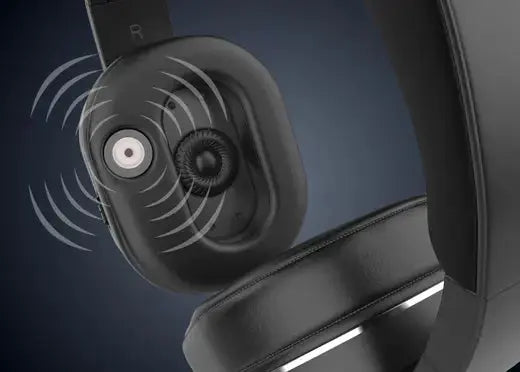
Some devices, like Spokeo, go further by combining bone conduction and air conduction — a patented approach called dual conduction — for richer, more natural sound reproduction.
How does bone conduction work?
The principle is straightforward: transducers placed against the temporal bones (just in front of the ears) convert audio signals into micro-vibrations. These vibrations travel through the skull and directly stimulate the cochlea, the hearing organ located in the inner ear.
The concept isn't new — Ludwig van Beethoven famously bit a rod attached to his piano to perceive music through bone conduction despite his deafness. What's new is the miniaturization and sound quality achieved by modern headphones.
The difference between air and bone conduction is essential:
- Air conduction: sound travels through air → ear canal → eardrum → ossicles → cochlea. Any obstacle along this path (wax, infection, malformation) degrades the signal.
- Bone conduction: sound is transmitted via vibration → skull bones → cochlea directly. The ear canal is entirely short-circuited.
Spokeo's patented dual conduction exploits both pathways simultaneously, delivering sound quality superior to either pathway alone.
Who are bone conduction headphones for?
Bone conduction headphones aren't limited to a single profile. They address a wide range of needs:
- People with conductive hearing loss — when the problem lies in the ear canal or middle ear (chronic otitis, otosclerosis, malformation), bone conduction bypasses the obstacle entirely.
- People who can't tolerate in-ear hearing aids — irritation, pain, plugged-ear sensation, feedback whistling: these are common reasons people abandon their hearing aids. Bone conduction headphones eliminate these irritants.
- Elderly people with reduced autonomy — especially those experiencing age-related hearing changes or difficulty handling small devices. No batteries to change, no ear mold to insert, no complex settings.
- Caregivers and healthcare professionals — with a device like Spokeo, it's the speaker who wears the microphone. The headset is simply placed on the patient's head. The result: clear communication with zero effort from the person with hearing loss.
The practical benefits of bone conduction headphones
Clear sound despite ear canal blockages
Earwax buildup, infections, narrow canals — these are common situations among elderly people, particularly those in care homes where ear care may be inconsistent. Bone conduction bypasses these obstacles and ensures intact sound transmission.
It's an effective alternative to traditional hearing aids for people who cannot or do not want to wear in-ear devices — whether for physical reasons (blocked canal) or practical ones (inability to handle the device daily).
Superior listening comfort
No ear insertion means zero discomfort and zero irritation. The ears remain open, which also allows awareness of the surrounding environment — an important safety advantage for elderly people living alone.
Extended wear is possible without discomfort, making it an ideal companion for longer listening sessions: watching television, listening to music, or following a podcast.
Bluetooth connectivity for everyday media
Modern bone conduction headphones connect wirelessly via Bluetooth to TVs, smartphones, tablets, and computers. This allows people with hearing loss to enjoy their programs at a comfortable volume without disturbing others — a frequent source of family tension.
Inclusive technology that involves the speaker
This is Spokeo's key innovation: instead of asking the person with hearing loss to manage a complex device, it's the speaker who wears the microphone. The directional Smart Mic captures the speaker's voice and transmits it directly to the headset. The listener doesn't have to do anything — just wear the headset.
For caregivers, nursing staff, and visitors in care homes, this fundamentally changes the quality of interactions.
Spokeo: dual conduction for better hearing
Winner of the Grand Prix at the Concours Lépine International 2025
Spokeo doesn't rely on bone conduction alone. Its patented dual conduction technology simultaneously combines air and bone conduction for optimal sound perception — even with earwax or partial ear canal blockage. A listening assistant designed for simplicity.
What sets Spokeo apart
Ideal usage situations
- Medical consultations: the healthcare professional wears the Smart Mic, the patient understands every word effortlessly.
- Care home visits: families can speak naturally with their loved one, even in noisy environments.
- Meals and social gatherings: conversations flow again without repeating or shouting.
- Television and media: in Bluetooth mode, Spokeo connects to the TV, smartphone, or tablet for personalized listening without disturbing others.
→ Discover the Spokeo kit: myspokeo.com
How to choose bone conduction headphones for hearing loss
Several criteria should be evaluated before making your choice:
- Type of hearing loss: bone conduction is particularly suited to conductive hearing loss and people who cannot or no longer want to wear traditional hearing aids, regardless of their degree of hearing loss. Medical advice (ENT specialist) is still recommended to assess your situation.
- Intended use: occasional (consultations, meals) or extended (TV, music)? An occasional-use device like Spokeo doesn't need the same battery life as a TV-dedicated headset.
- Comfort and ergonomics: check the weight, fit system, and pressure on the temporal bones. Headphones that are too tight become uncomfortable after 30 minutes.
- Connectivity: Bluetooth is essential for connecting to TV or phone. Check compatibility with your devices.
- Budget: basic models start at €50, specialized bone conduction headphones range from €150 to €500, and Spokeo (dual conduction + Smart Mic) is €598 incl. tax — with no audiologist fees or prescription required.
Important: bone conduction headphones do not replace a hearing assessment. If you suspect hearing loss, consult an ENT specialist for an audiogram. Some situations benefit from a combination of solutions: for example, hearing aids for everyday use + a bone conduction headset like Spokeo for specific communication situations.
Frequently asked questions about bone conduction headphones
How do bone conduction headphones work for hearing loss?
Bone conduction headphones transmit sound vibrations directly to the inner ear through the skull bones, bypassing the ear canal and eardrum. This allows hearing even with earwax buildup, infections, or ear canal blockages. Some models like Spokeo combine bone and air conduction (dual conduction) for richer sound quality.
Can you wear bone conduction headphones with hearing aids?
Yes. Bone conduction headphones don't block the ear canal, making them compatible with in-ear or behind-the-ear hearing aids. Many users wear Spokeo alongside their hearing aids in challenging situations such as noisy environments or medical consultations.
Are bone conduction headphones suitable for elderly people?
Yes, this is one of their key advantages. The headset is easy to put on and remove, requires no ear insertion, and works even with earwax buildup common in seniors. Models like Spokeo are ready to use out of the box, with no complex settings or audiologist visits required.
What is the difference between bone conduction and air conduction?
Air conduction transmits sound through the ear canal to the eardrum (like regular earphones). Bone conduction transmits sound vibrations directly through the skull bones to the inner ear, bypassing the canal entirely. Spokeo's patented dual conduction combines both pathways simultaneously for optimal sound perception.
Can bone conduction headphones connect to a TV?
Yes. Bluetooth-enabled bone conduction headphones like Spokeo connect wirelessly to TVs, phones, tablets, and computers. This allows people with hearing loss to watch TV at a comfortable volume without disturbing others.
How much do bone conduction headphones for hearing loss cost?
Prices range from around €50 for basic models to over €500 for specialized devices. Spokeo, which combines patented dual conduction and a directional smart microphone, is priced at €598 including tax, with no prescription needed. Unlike traditional hearing aids (€1,500 to €3,000), it requires no audiologist follow-up.
30-day free trial
Not sure if Spokeo is right for you?
Try Spokeo at home for 30 days. If it's not the right fit, we'll refund you in full, no questions asked.
Discover the 30-day trial →Conclusion
Bone conduction headphones represent a significant advancement for people with hearing loss, caregivers, and healthcare professionals. By bypassing the ear canal, they offer a solution where traditional hearing aids fail or are poorly tolerated.
With Spokeo's patented dual conduction — winner of the Concours Lépine 2025 — this technology takes another leap forward: richer sound, a directional microphone that involves the speaker, and a simplicity of use that makes it accessible to everyone, including those with reduced autonomy.
The key is not to let hearing loss go untreated. Whether it's a bone conduction headset, a traditional hearing aid, or a listening assistant like Spokeo, any solution that maintains social connection is worth considering.